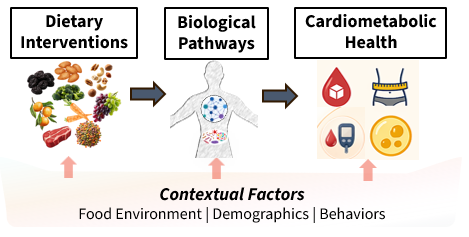
Does a food, a dietary pattern, or a set of dietary instructions improve cardiometabolic health? The question seems straightforward but is hard to answer rigorously, because the effects of diet arise from multiple interacting biological processes, are modified by exercise and other lifestyle behaviors, and can differ markedly across individuals, populations, and their environments. Our program integrates three connected lines of work to determine not only whether dietary and lifestyle interventions can improve health, but also how those effects occur, and for whom.
Human interventions testing whole foods, dietary patterns, and lifestyle effects
Nutrition science has progressed from a focus on individual nutrients, to recognition of how the food matrix shapes nutrient action, and more recently, to whole foods (foods that retain all components of the original source) and dietary patterns (specific combinations of foods consumed in a person's diet), the latter two of which anchor our intervention research. Whole-food interventions test how a single food affects health. Dietary pattern interventions test how an overall way of eating improves health under real-world conditions.
Across these randomized controlled trials, we focus on interrelated dimensions of cardiometabolic health, including blood glucose regulation, fat metabolism, adiposity, and inflammation as contributors to cardiometabolic risk. We obtain measurements in the fasting state, which are directly relevant for medical diagnoses, and pair these with dynamic assessments, such as glucose or fat challenge tests and immune-cell stimulation assays, so that the data reflect metabolism at rest as well as the body's regulated responses to food exposures or other stimuli. We include complementary outcomes such as appetite, cognition, stress, physical activity, and sleep when these help clarify how dietary change may influence eating behavior, adherence, or well-being. We also study diet within lifestyle interventions, examining how diet-related outcomes change within broader behavioral interventions in young adults.
Mechanisms: the gut microbiome and omics
To explain how dietary effects occur, we go beyond conventional cardiometabolic measures to the biological pathways that may underlie diet-induced responses. Gut microbiome (metagenomic), metabolomics, and transcriptomics data are generated prospectively within our trials, and interpreted alongside clinical and physiological outcomes. Metagenomic sequencing of stool samples provides taxonomic profiling of gut microbial communities and, when appropriate, functional interpretation of what those communities can do. Metabolomics profiles thousands of small molecules in blood, including some produced by gut microbes, in the fasting state and during a glucose challenge. Transcriptomics profiles gene expression in blood and adipose tissue.
Pathway and network interpretation moves beyond lists of altered microbes, metabolites, or genes to identify biological patterns that may explain cardiometabolic responses, and microbiome-metabolomics integration interprets diet-related changes across connected microbial and human metabolic systems rather than as isolated findings. We have also applied metabolomics in animal models of weight loss and GLP-1 signaling, and we have studied exercise as a non-diet behavior that acts on the same biological systems, through our resistance training trial and a systematic review of exercise and the gut microbiome.
Contextual factors: food environment, food security, demographics, and behaviors
Why do individuals and populations respond differently to the same diet? We test how contextual factors, including the food environment, food security, demographics, and behaviors, shape both what people eat and how their bodies respond to dietary change. Our earlier work used qualitative and cross-sectional methods to study the food environment and food security of students on a college campus in a food desert. Our systematic reviews have examined how clinical nutrition interventions represent racial and ethnic groups and whether they account for group-specific eating patterns, diet acceptability, and socioecological context.
Within our own trials, we examine race, sex, and food security a priori as moderators of cardiometabolic and associated health responses. Through USDA Multistate Project NC1193, a collaboration of investigators across 18 states, we lead the integration of lifestyle, behavioral, and biological data collected over the past decade to examine how contextual and behavioral factors modify responses to health interventions in young adults.
Pre- and post-ingestive controls of food intake
The sensory properties of food, that is, taste, texture, odor, flavor, and even expectations regarding the food, can influence food choice, digestion, and metabolism. Sensory stimulation prior to ingestion elicits a wide array of rapid physiological processes termed cephalic phase responses that enable the body to mount an adaptive response to impending food ingestion. Our work in this area has examined the cephalic phase insulin response to nutritive and low-calorie sweeteners in solid and beverage form, and whether that response influences appetite and energy intake at a subsequent meal.
Apart from sensory properties, factors such as macronutrient composition, food form, and dietary protein have a considerable influence on appetite and energy balance. We have examined the effects of food form on appetite and energy balance, the effects of dietary protein on fullness through meta-analysis, and appetitive and neural reward responses to nut consumption. These pre- and post-ingestive factors have appetitive and consummatory influences that guide food intake, nutrition, and consequently, health and disease, and they inform the appetite and eating behavior measures in our intervention trials.
Research funding
| Project | Grant | Role | Years |
|---|---|---|---|
| Current | |||
| Effects of conventional vs. forage-finished beef products on cardiometabolic health in humans | CAFNR Research Support | Co-PI | 2022–present |
| Promotion of Health and Nutrition in Communities of Emerging Adults | USDA Multistate Project NC1193 | MU Head and Chair of Big Data Objective | 2023–2031 |
| Identifying optimal cattle genetics for grass-finished beef production systems | USDA NC-SARE | Co-I (PI: Jordan Thomas, University of Missouri-Columbia) | 2025–2028 |
| Effects of grape consumption on the immune-gut axis in obesity | California Table Grape Commission | PI | 2025–2026 |
| Dietary ketone supplementation as a novel therapy to attenuate the adverse cardiorenal consequences of high dietary salt in middle-aged and older adults | NIH R21 AG087524, NIA | Co-I, Subaward PI at MU (PI: Austin Robinson, Indiana University Bloomington) | 2024–2026 |
| Doctoral trainee support | CAFNR Matching Assistantship Program (C-MAP) | Mentor | 2023–2026 |
| Past | |||
| Effects of whole almonds on immune health and responsiveness in adults with obesity | Almond Board of California | PI | 2022–2025 |
| Effects of functional food diets on cardiometabolic and metabolomics profiles in minority youth | NIH R00 MD012815, NIMHD | PI | 2020–2025 |
| Effects of a personalized functional food intervention on gene expression (transcriptomics) profiles | MU DNA Core Tier 1 Sequencing Grant | PI | 2021–2024 |
| Pathway to Independence Award | NIH K99 MD012815, NIMHD | PI | 2018–2020 |